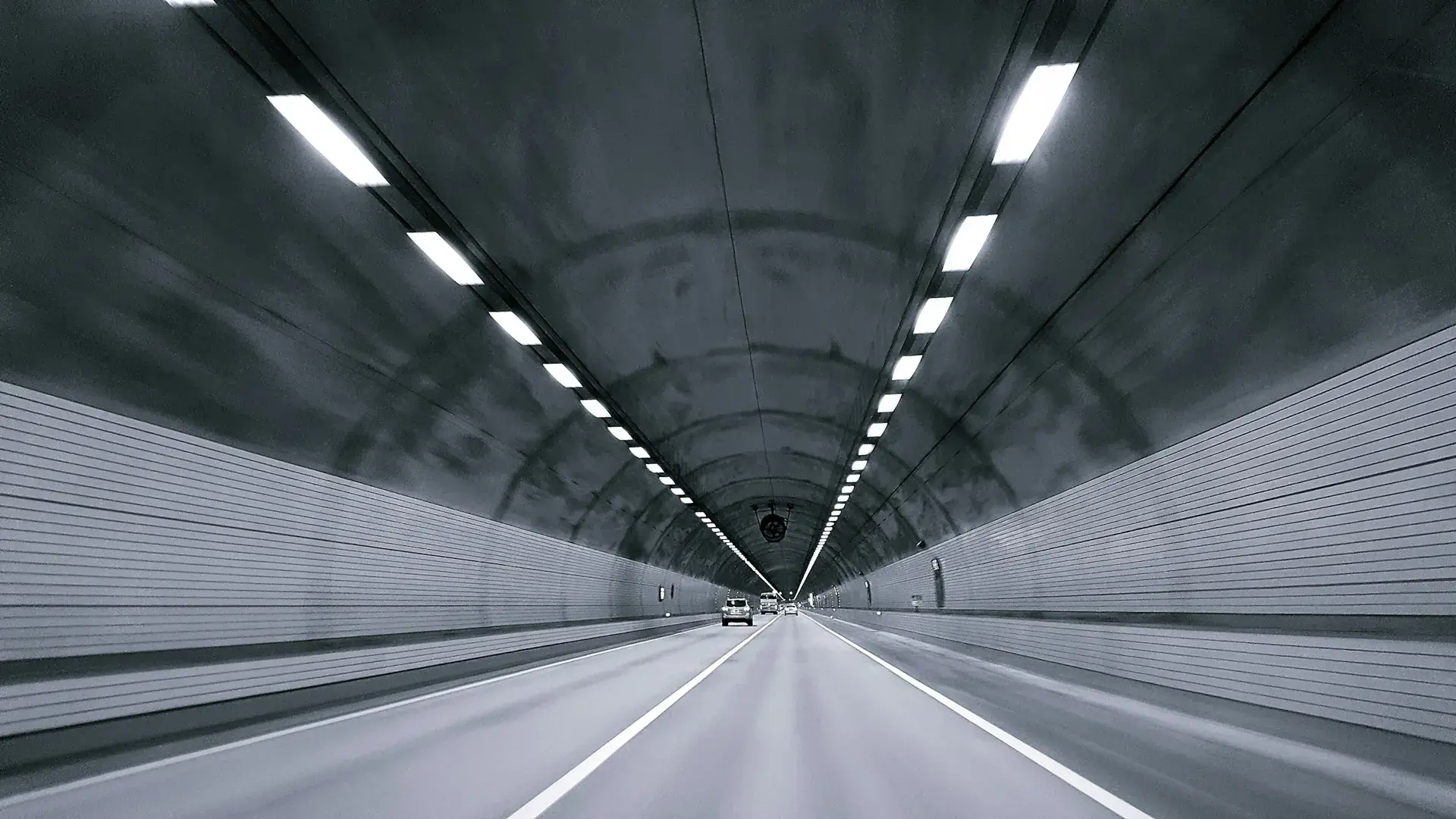
Deluge and water mist are the two fixed firefighting technologies specified for tunnel fire protection worldwide. Both divide a tunnel into fire zones and discharge automatically onto a detected fire — the difference is in how they get water onto the fire, and what that difference costs in tanks, pipework, and retrofit complexity.
How deluge works
A deluge system uses large-bore pipework and open sprinkler-type heads to flood an entire fire zone with a high volume of water at low pressure. It is a mature, well-understood technology, but its water demand is substantial: a typical deluge zone can require several times the flow rate of an equivalent water mist zone to achieve comparable fire control, because coarse droplets present far less surface area per litre of water than fine mist droplets.
How high-pressure water mist works
A high-pressure water mist system operates at 50–140 bar, atomising water into droplets under 200 microns (Dv0.9). At that droplet size, water behaves almost like a gas for heat-transfer purposes: it absorbs heat faster per litre, flashes to vapour that locally displaces oxygen at the fire source, and forms a cloud that attenuates radiant heat to the rest of the zone — while using dramatically less water than deluge for the same cooling effect.
The practical differences
| Factor | Deluge | High-pressure water mist |
|---|---|---|
| Water demand | High — baseline | Up to 80% less |
| Pipe diameter | Large bore | Small-bore stainless tubing |
| Tank and pump size | Large | Compact |
| Retrofit into existing tunnel | Disruptive — large pipe runs | Far easier — light pipework |
| Water damage / clean-up | Significant | Minimal |
The pipe-diameter difference is not a minor detail. A deluge retrofit into an operating tunnel often means partial closures to accommodate large-bore pipe runs and larger valve chambers. Water mist's small-bore tubing threads through existing service ducts with far less disruption — a meaningful advantage for India's programme of upgrading existing tunnels as well as building new ones.
Where each technology fits
Deluge remains a reasonable choice where water supply is unconstrained and civil works are being built from scratch with generous space allocated for large valve chambers. High-pressure water mist is the stronger choice wherever water supply, tank footprint, retrofit disruption, or fire-zone water damage are constraints — which, in practice, describes most Indian road, metro and rail tunnel projects today.
For the zoned design approach we use in Indian tunnel projects, see tunnel fixed firefighting systems. For the underlying droplet physics, see High-Pressure vs Low-Pressure Water Mist.