Applications · Paint booths
Paint Booth Fire Suppression under NFPA 33
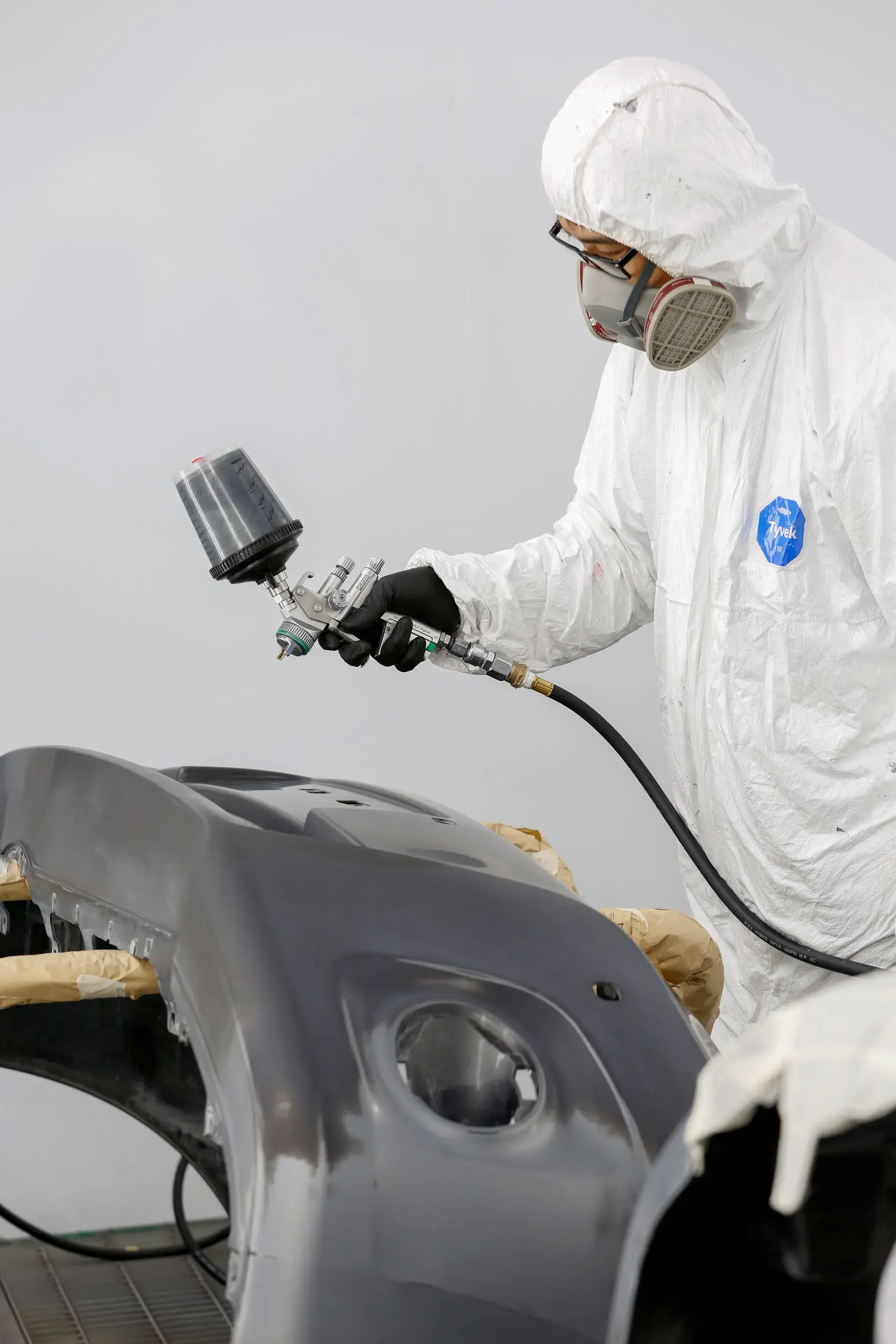
A paint spray booth combines an ignition source, atomised solvent overspray, and a confined airflow path — a fire scenario NFPA 33 treats with particular seriousness. Water mist attacks a solvent pool or overspray fire by cooling it and displacing oxygen at the seat of the fire, without the cleanup and equipment damage a conventional deluge or foam discharge leaves behind in OEM and automotive-ancillary paint shops.
Risk
The booth fire scenario
Overspray accumulates on booth walls, filters and ductwork as a combustible film. A source of ignition — static discharge, a faulty fixture, or spontaneous combustion of oily rags — can ignite either the solvent-laden air or the accumulated overspray, and the booth’s own airflow can spread flame toward the filter bank and exhaust plenum in seconds.
That airflow is what separates a booth fire from an ordinary industrial one. The ventilation that makes the booth safe to work in is also a delivery mechanism: it carries flame along the extract path toward the filter bank, where the accumulated overspray is thickest and the fire finds its largest fuel load. Suppression that treats the spray zone alone, and leaves the filter bank and plenum unconsidered, protects the part of the booth least likely to sustain the fire.
Design basis
NFPA 33 paired with NFPA 750
NFPA 33 (Standard for Spray Application Using Flammable or Combustible Materials) governs booth construction, ventilation interlocks and permitted suppression methods; water mist systems meeting NFPA 750 are an accepted option. Mistelix booth systems are designed to both standards together — the booth’s ventilation interlock, detection, and mist zone are treated as one integrated system rather than bolted-on separately.
The division of responsibility between the two documents is worth being explicit about in a specification. NFPA 33 governs the booth: how it is built, how it is ventilated, how spray application is interlocked, and what suppression is acceptable for it. NFPA 750 governs the mist system inside it: component requirements, water supply, and the evidence a water mist system is expected to carry. A specification that cites one without the other leaves a gap that shows up at approval, not at design. Read the standard in detail in Paint Booth Fire Suppression under NFPA 33.
Layout
Nozzle layout over the spray zone
Nozzles are arranged in a grid over the spray zone and filter bank, with flame or heat detection lines positioned to catch a fire at floor level or in the plenum before it reaches the exhaust duct.
Detection and interlock
The booth has to stop, not just get wet
NFPA 33 treats spray application and booth ventilation as interlocked functions, and suppression belongs inside that same interlock. Detection should stop spray application, put the ventilation into its designed state, and release suppression as one sequence — not as three systems that happen to share a building.
The practical failure mode is a mist system retrofitted without that tie-in: the nozzles discharge while the extract fan keeps pulling air across the fire and the spray gun keeps feeding it. Where the booth is part of a wider line, the same signal that releases suppression is normally the one that halts the conveyor and alerts the plant control system, so the incident stops at the booth rather than propagating down the line.
Why water mist here
Less water, less clean-up
A deluge or foam discharge into a booth can mean days of cleanup, contaminated overspray filters, and corrosion risk to booth electronics and robotics. A water mist discharge uses a fraction of the water, evaporates faster, and lets a production line return to service sooner — a direct line-uptime argument for OEM and auto-ancillary paint shops running tight production schedules.
For a paint shop, that is usually the argument that decides it. The suppression performance of the alternatives is not in dispute; what differs is the state the booth is left in afterwards, and how much of the downtime is fire damage versus clean-up of the suppression itself. Smaller water volume also means smaller tanks, smaller pumps and less drainage provision — which matters inside an existing plant where the floor area was committed years ago. How high-pressure water mist works covers the physics behind that difference.
Reference specification
Booth system parameters
| Operating pressure | 50–140 bar |
|---|---|
| Droplet size (Dv0.9) | < 200 µm |
| Standard basis | NFPA 33 / NFPA 750 |
| Activation | Flame/heat detection, booth-interlocked |
FAQ
Common questions
- Does NFPA 33 allow water mist in a paint spray booth?
- Yes. NFPA 33, the Standard for Spray Application Using Flammable or Combustible Materials, sets out how a booth is built, ventilated and interlocked, and which fixed suppression methods are acceptable. Water mist systems engineered to NFPA 750, the Standard on Water Mist Fire Protection Systems, are among them. The two standards are read together: NFPA 33 governs the booth, NFPA 750 governs the mist system inside it.
- What makes a paint booth fire different from an ordinary industrial fire?
- Three things happen at once. Atomised solvent is already airborne in ignitable concentration, combustible overspray has built up as a film on walls, filters and ductwork, and the booth's own ventilation is actively moving air toward the filter bank and exhaust plenum. That airflow is what turns a local ignition into a duct fire in seconds, which is why detection and suppression have to be interlocked with the ventilation rather than operating independently of it.
- How does water mist compare with deluge or foam in a spray booth?
- The suppression performance is not the only question — the recovery is. A deluge or foam discharge leaves contaminated filters, standing water and corrosion exposure for booth electronics and robotics, and the line typically stays down for days. Water mist uses a fraction of the water volume and evaporates far faster, so the clean-up is smaller and the line returns to service sooner. For a paint shop running to takt time, that difference is usually the deciding argument.
- Does the fire suppression system have to shut the booth down?
- In practice yes, and by design. NFPA 33 treats booth ventilation and spray application as interlocked functions, so detection should stop spray application and put the ventilation into its designed state at the same time as it releases suppression. A mist system bolted on without that interlock leaves the booth feeding air to the fire while the nozzles are trying to cool it.
Next step
Request a booth system concept
Send us booth dimensions, airflow direction, and line takt time and we return a concept sized to your production constraints.
Request technical assessment