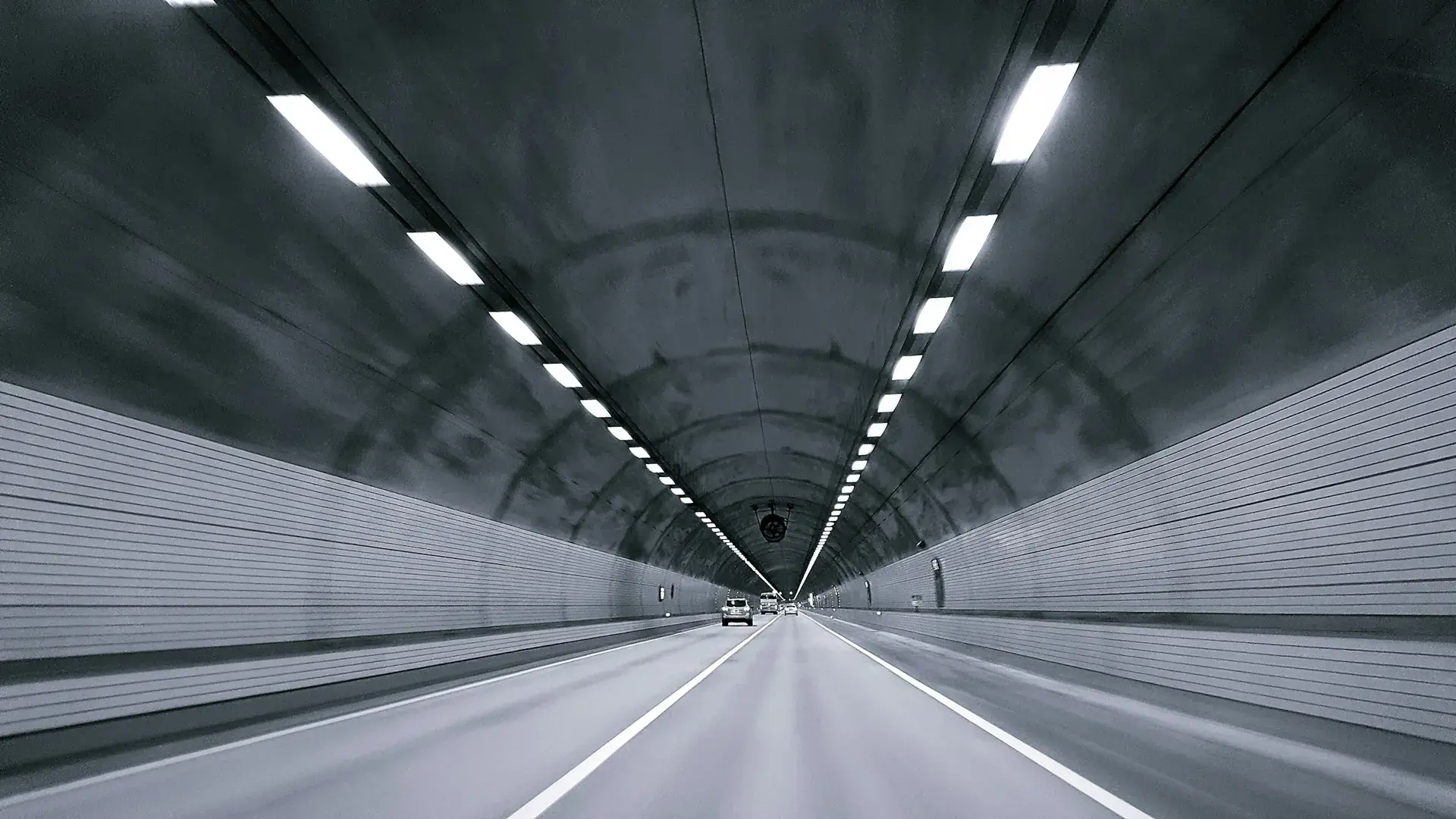
Applications · Tunnels
Tunnel Fire Fighting Systems: High-Pressure Water Mist
A tunnel fire fighting system — a fixed firefighting system, or FFFS — detects a fire automatically and discharges water onto it in the first minutes, before crews can reach it. Mistelix designs it as high-pressure water mist: water pumped at 50–140 bar (≈725–2,030 psi) through fine nozzles, producing droplets under 200 microns that use a fraction of the water a deluge system requires. Tunnel zones are designed at 25–30 metres (≈82–98 ft), activating the fire zone plus a guard zone on each side.
Road, rail and metro tunnels share one problem: every bore is a confined space where a vehicle, cable or rolling-stock fire can escalate faster than firefighters can reach it. A fixed firefighting system is the only protection that acts in the first minutes, before any external response arrives.
Why tunnels add FFFS
Why do tunnel owners add a fixed fire fighting system?
Road tunnel fires — the 1999 Mont Blanc and Tauern tunnel fires among them — established the same lesson worldwide: ventilation and signage alone do not stop a heavy goods vehicle or fuel fire from escalating. Metro tunnels add a second driver — cable and rolling-stock fires in a space with no natural ventilation and constrained evacuation. PIARC, the World Road Association, sets out current practice and recommendations for FFFS in road tunnels in its 2016 report.
What an FFFS is
What is a tunnel fixed fire fighting system?
An FFFS is a permanently installed system — water mist or deluge — that detects a fire automatically and discharges suppression agent directly onto it, without waiting for a fire crew to arrive and connect hoses. In a tunnel, this buys the minutes needed for self-evacuation and reduces the heat release rate reaching the structure, ventilation equipment and following vehicles.
Design basis
How does zoned water mist work in a tunnel?
Mistelix tunnel systems divide the bore into 25–30 m protection zones, each with its own section valve and bank of open nozzles. Detection identifies the fire zone and opens three sections together — the fire zone plus one guard zone on each side, so the discharge envelope always covers fire spread along the traffic axis. The rest of the tunnel remains dry, minimising water use, run-off, and post-incident clean-up.
Standards
Which standards govern tunnel fire fighting systems?
There is no single global rule. The tunnel’s fire life-safety standard decides whether an FFFS is warranted and what it must work alongside; the water mist standard governs the system itself. Mistelix designs with reference to NFPA 502 and NFPA 750, and to the project’s governing standard where one is specified.
- United States
- NFPA 502, Standard for Road Tunnels, Bridges, and Other Limited Access Highways, for road tunnels (NFPA); NFPA 130, Standard for Fixed Guideway Transit and Passenger Rail Systems, for rail and metro (NFPA); and NFPA 750 for the water mist system itself (NFPA). More in NFPA 502 Explained and NFPA 130 Explained.
- Europe
- The EU Tunnel Directive 2004/54/EC sets minimum safety requirements for tunnels on the trans-European road network (EUR-Lex), and water mist systems are designed and fire-tested under the EN 14972 series. National guidelines sit on top, such as Germany’s RABT (FGSV). More in The EU Tunnel Directive and Fixed Firefighting and, for German research on how tunnel users respond when a system discharges, VdS 3188 Explained.
- Australia
- AS 4825, Tunnel fire safety, gives the framework for fire safety systems in new road, rail and bus tunnels (Standards Australia), and AS 4587 covers the design, installation and commissioning of water mist systems (Standards Australia). More in AS 4825 Explained.
- International guidance
- PIARC, the World Road Association, sets out current practice for fixed fire fighting in report 2016R03 and sizes design fires in report 2017R01EN (explained here). The EU-funded UPTUN research programme ran full-scale tunnel fire tests and produced engineering guidance for water-based fire fighting systems in tunnels (UPTUN R251).
- Middle East
- In Qatar, road tunnel fire and life safety systems on Public Works Authority projects are designed to NFPA 502 as modified by Ashghal’s IAN 020 (Ashghal); rail projects that developers undertake in Dubai answer to NFPA 130, with Dubai Civil Defence as the authority having jurisdiction (RTA). More in Tunnel Fire Safety in the Gulf and Water Mist Approval in the Gulf.
- India
- India has no single tunnel FFFS code yet, so projects reference NFPA 502 and PIARC — see Fixed Firefighting Systems for Indian Road Tunnels.
Mistelix has not participated in the SOLIT2 large-scale tunnel fire tests, but plans full-scale testing of its own following the SOLIT2 test methodology — see the honest status on our standards and approvals page and our sourced account of what the SOLIT tunnel fire tests showed.
Water demand
Water mist or deluge in a tunnel?
A deluge system’s large-bore pipework and open sprinklers can demand several times the water flow of an equivalent water mist zone for comparable heat absorption, because mist droplets present far more surface area per litre. That difference cascades into smaller tanks, smaller pumps, and lighter distribution pipework — a material retrofit advantage in an operating tunnel where shutting a bore for construction is expensive. Full comparison in Water Mist vs Deluge in Tunnels.
Design reference
Reference specification
| Zone length | 25–30 m (≈82–98 ft) |
|---|---|
| Operating pressure | 50–140 bar (≈725–2,030 psi) |
| Droplet size (Dv0.9) | < 200 µm |
| Activation | Automatic detection + section valve |
| Standard basis | NFPA 502 / NFPA 750 |
For tender teams
What should a tunnel FFFS tender package include?
- Tunnel bore length, cross-section, and gradient
- Traffic type and risk category (or expected rolling stock, for metro)
- Ventilation strategy (longitudinal, transverse, or semi-transverse)
- Governing standard (NFPA 502 or NFPA 130, national rules under the EU Tunnel Directive, AS 4825, or client-specified)
- Existing or planned detection system
Send these details through our technical assessment form and we return a system concept, not a quote template.
FAQ
Frequently asked questions
Is a fixed fire fighting system mandatory in road tunnels?
There is no single global rule. The requirement comes from the governing standard and the project's fire life-safety design: NFPA 502 treats an FFFS as part of the strategy evaluated for each tunnel, with the authority having jurisdiction deciding what is mandatory; Australian projects reference AS 4825; and in India, which has no dedicated tunnel-FFFS code yet, requirements are set project by project with reference to NFPA 502 and PIARC. In practice, tunnels above a defined length or traffic risk category are the ones most often specified with an FFFS, typically water mist or deluge.
Water mist or deluge — which is right for a tunnel project?
Deluge is the older, higher-water-demand approach: large-bore pipework and open sprinklers flood an entire zone. High-pressure water mist achieves comparable or better cooling and radiant-heat control at a fraction of the water flow, with small-bore pipework that is far easier to retrofit into an operating tunnel. See our detailed comparison in Water Mist vs Deluge in Tunnels.
How long is a typical protection zone?
Mistelix designs tunnel zones at 25–30 m (≈82–98 ft), matching the section-valve spacing used internationally so that only the zone containing the fire discharges, limiting water use and clean-up.
What pressure does a tunnel water mist system run at?
Mistelix tunnel systems operate at 50–140 bar (≈725–2,030 psi), which places them in the high-pressure class of water mist. See High-Pressure vs Low-Pressure Water Mist for how the pressure classes are defined.
Does water mist interfere with tunnel ventilation strategy?
No — water mist is designed to work alongside, not against, longitudinal or transverse ventilation. The droplet cloud cools the fire and slows radiant spread while ventilation continues to manage smoke stratification and visibility for evacuation.
Related reading
Go deeper
Next step
Request a tunnel system concept
Tell us the bore length, ventilation strategy, and governing standard for your project.
Request technical assessment