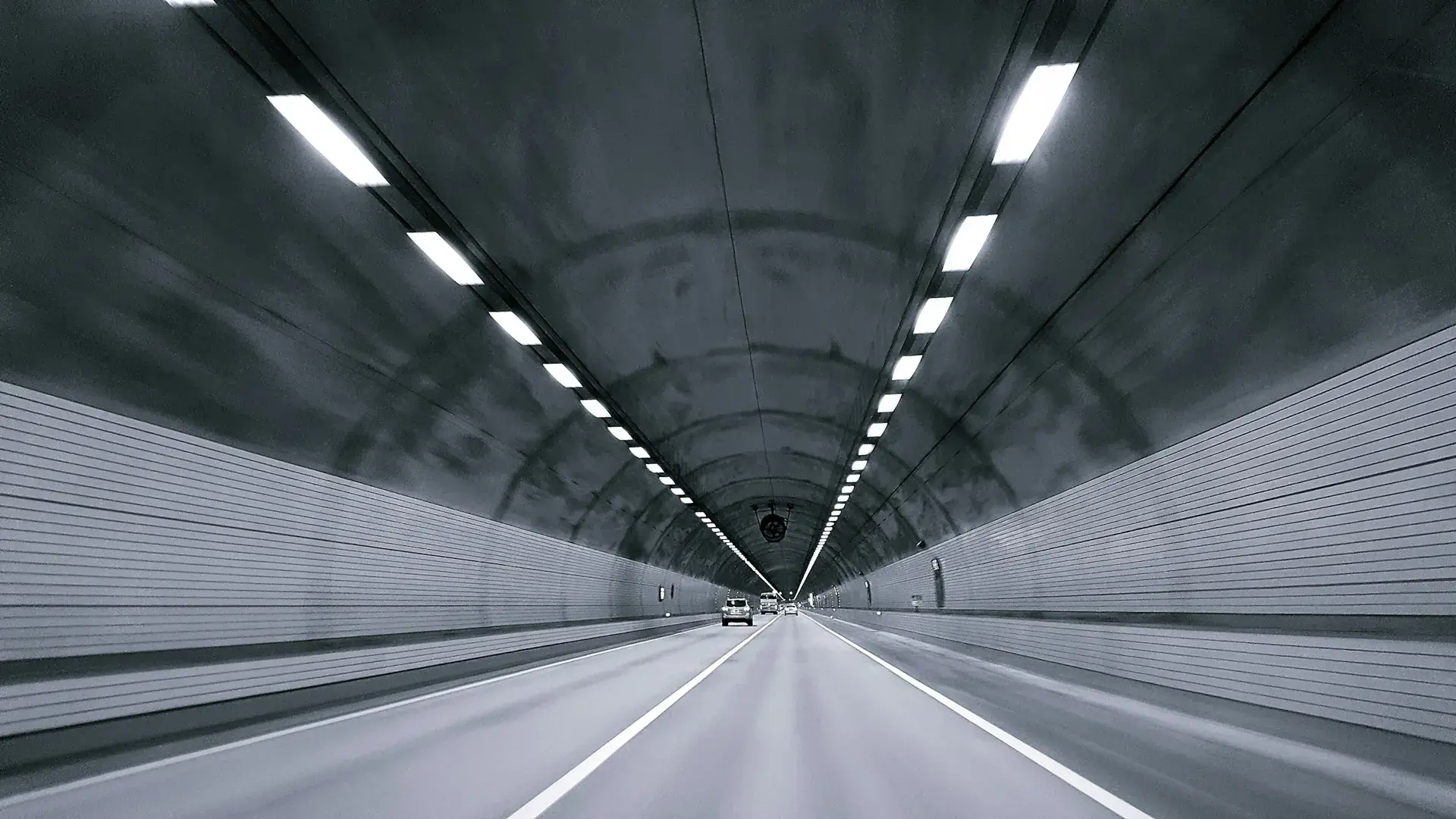
Directive 2004/54/EC of the European Parliament and of the Council, adopted on 29 April 2004, sets the minimum safety requirements for tunnels in the Trans-European Road Network. It is the document every European road tunnel project is measured against, and it is routinely misread on one specific point.
It does not require a fixed firefighting system. Not for any tunnel length, not for any traffic category. If you are looking for the clause that mandates one, it is not there.
Yet fixed firefighting systems are being specified across Europe in growing numbers. Understanding why is the difference between writing a submission that gets approved and one that gets sent back.
What the directive actually requires
The directive applies to tunnels longer than 500 metres forming part of the TERN. Rather than prescribing equipment alone, it builds an accountability structure — and that structure is the part most suppliers ignore.
It establishes four roles. The Administrative Authority is responsible for ensuring compliance. The Tunnel Manager is responsible for the tunnel in operation. The Safety Officer coordinates preventive and safeguarding measures independently of the operator. The Inspection Entity carries out periodic inspections, at intervals not exceeding six years.
It requires safety documentation for every tunnel, maintained through design, construction, commissioning and operation, and it requires a risk analysis where a tunnel has particular characteristics or where a Member State proposes to derogate from the minimum measures. Annex I sets out those minimum measures: emergency exits and their spacing, lay-bys, ventilation, lighting, drainage, communications, fire-fighting water supply.
Existing tunnels had to be brought into compliance by 30 April 2019.
Why FFFS appear anyway
Three routes, and they compound.
The risk analysis route. The directive is a floor, not a ceiling. Where a tunnel presents characteristics the minimum measures do not adequately address — steep gradients, high heavy goods vehicle proportions, restricted emergency access, an immersed or sub-sea alignment, or an underground junction — the risk analysis is where additional measures are justified. A fixed firefighting system is one of the measures that gets justified there.
National rules that go further. Member States transpose the directive into national law and are free to exceed it, and several do. Germany applies RABT, the guideline for the equipment and operation of road tunnels; Austria applies the RVS series; other national frameworks impose their own requirements on ventilation, detection and suppression. A project compliant with the directive alone may still fail the national rule it is actually being approved against, so the first question on any European tunnel is which national framework governs.
Operator and insurer expectation. Beyond regulation, the parties who carry the consequences of a tunnel closure increasingly ask for fire growth to be controlled rather than merely ventilated. A prolonged closure on a strategic route is an economic event, and that argument is made in the risk analysis rather than in the code.
What the FFFS is expected to achieve
The design objective is control, not extinguishment. A fully developed heavy goods vehicle fire is not reliably extinguished by any fixed system, and a supplier promising otherwise is describing something other than the design case.
What the system is judged on is limiting fire growth and peak heat release, holding tenable conditions on the escape route during the evacuation window, protecting the tunnel structure from the temperatures that cause spalling and long-term damage, and improving the conditions the fire service arrives into. Those objectives are set against a design fire, and the design fire is where PIARC work is commonly used as the technical reference across European projects.
Where EN 14972 takes over
The directive and its national transpositions govern the tunnel. The water mist system inside it is governed by EN 14972 — Part 1 for design, installation, inspection and maintenance, and the application-specific fire test protocol for the risk in question. The two documents do different jobs and a specification should cite both, stating which governs in the event of conflict.
This is where European projects differ most sharply from prescriptive sprinkler work. Water mist carries no generic spacing table. The design rules for a given system come from what that system demonstrated in full-scale fire testing, recorded in the manufacturer's DIOM manual. A water mist system without a test-backed DIOM has no design basis, whatever its datasheet says.
What belongs in the submission
Three documents, and an approving authority is entitled to all of them:
- The full-scale fire test report, naming the protocol and the accredited laboratory that ran it, together with the nozzle designation, spacing and coverage limits, installation heights, operating pressures, detection method and ventilation conditions during the test.
- The component test reports behind nozzles, valves and pumps.
- The DIOM manual, which is where the design rules the project relies on actually live.
The common substitution is a component certificate offered in place of a system fire test. They are not equivalent: a certified nozzle says nothing about whether an arrangement of those nozzles controls the design fire your tunnel is built around.
Where Mistelix stands
Our systems are designed to EN 14972 and to NFPA 750 where a project specifies it. Full-scale fire testing to the EN 14972 series at an accredited laboratory is scheduled and not yet complete, and we say so rather than implying evidence we do not hold. Our EN 14972 roadmap sets out what exists at each stage, and the standards ledger states our position line by line.
If your European tunnel project needs a water mist system and you want to know what documentation will exist by your commissioning date, ask us directly. You will get the roadmap, not a sales pitch.