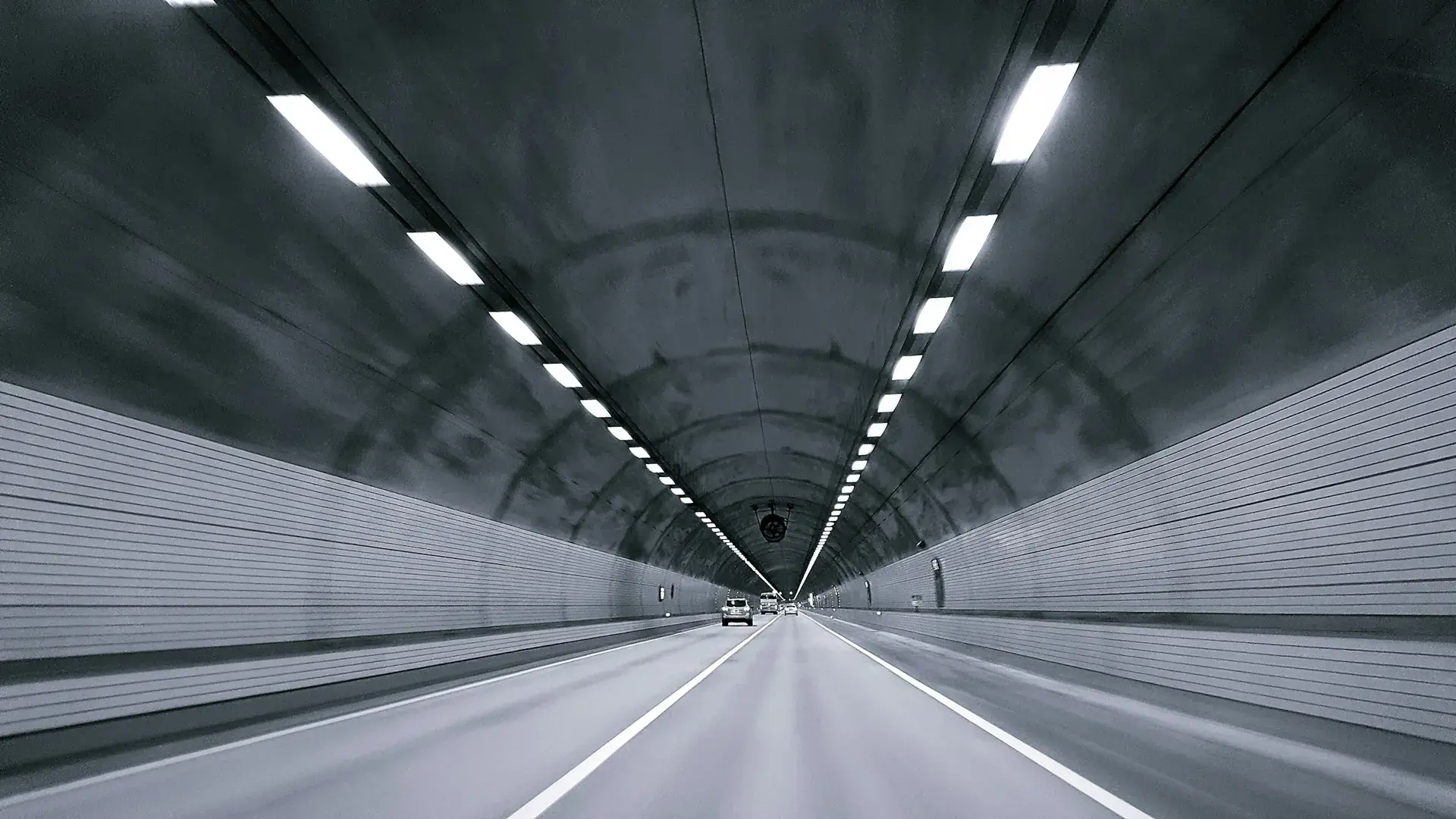
India's national highway and metro rail programmes are building tunnels at a scale the country has not seen before — long Himalayan road bores, urban metro sections running under dense city centres, and expressway tunnels bypassing congested terrain. Every one of these is a confined space where a vehicle fire, an electrical fault, or a cable fire can escalate far faster than an external fire brigade can respond. That gap is exactly what a fixed firefighting system (FFFS) exists to close.
What a fixed firefighting system does
An FFFS is a permanently installed suppression system — water mist or deluge — that detects a fire automatically and discharges directly onto it without waiting for a crew to arrive, connect hoses, and enter the tunnel. In practice this means the system acts in the first minute or two of a fire, the window in which heat release rate and smoke production are still low enough for occupants to self-evacuate safely.
Three things distinguish an FFFS from ordinary tunnel safety equipment:
- Automatic activation — detection triggers suppression without human intervention, because in an unmanned or lightly monitored tunnel there may be nobody present to trigger it manually in time.
- Zoned discharge — modern systems, whether deluge or water mist, divide the tunnel into fire zones and discharge only the zone containing the fire, rather than flooding the entire bore.
- Design basis in an internationally recognised standard — most Indian tunnel projects reference NFPA 502 for the tunnel life-safety basis and NFPA 750 for the water mist system itself, since India does not yet have a single dedicated domestic FFFS mandate.
Why this matters now, not later
Tunnel fires are rare, but their consequences are disproportionate to their frequency. International incidents — the Mont Blanc and Tauern tunnel fires among them — showed that ventilation and signage alone cannot stop a heavy goods vehicle fire from escalating into a mass-casualty event. As Indian tunnels grow longer and carry higher traffic densities, and as metro rail systems extend cable-heavy tunnel networks under major cities, the same physics applies here. FFFS is moving from an optional extra to an expected line item at design stage, particularly for tunnels above a defined length or risk category.
Water mist vs deluge for FFFS
Both technologies satisfy the "automatic, zoned suppression" definition of an FFFS, but they differ substantially in water demand, pipe size, and retrofit practicality. High-pressure water mist achieves comparable cooling and radiant-heat control to deluge at a fraction of the water flow, because its fine droplets present far more surface area per litre. That translates into smaller tanks, smaller pumps, and small-bore distribution pipework that is dramatically easier to install in an operating or under-construction tunnel. We cover this comparison in full detail in Water Mist vs Deluge in Tunnels.
What a tender package should specify
Whichever technology a project selects, the tender documentation needs to specify: bore length and cross-section, traffic type or rolling stock, ventilation strategy, the governing standard, and the existing or planned detection system. These five inputs are enough for a system designer to return a zone-by-zone concept rather than a generic quotation.
See our tunnel fixed firefighting systems application page for the full zoned water mist design approach, or read NFPA 502 Explained: Fire Fighting Systems in Road Tunnels for the standards background.