SOLIT is one of the most frequently cited pieces of third-party research behind tunnel fixed firefighting system decisions — and one of the most frequently misdescribed. It is worth being precise about what it was, what it measured, and where the published record stops.
What SOLIT was
SOLIT was a German research programme examining the performance of fixed firefighting systems in road tunnels. Its second phase, SOLIT2, ran the large-scale test campaign most people are referring to when they cite it.
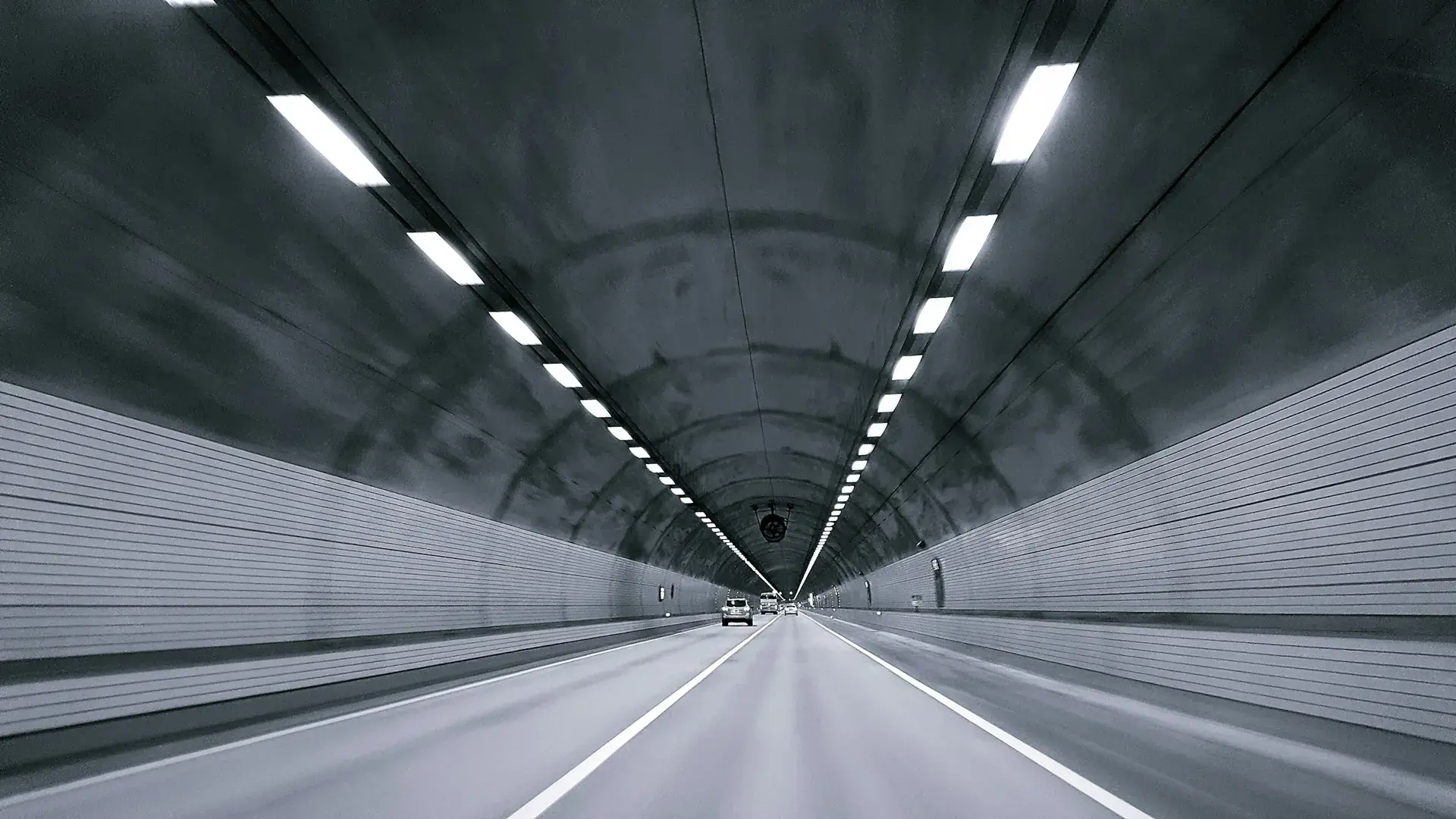
The tests were conducted at the Tunnel Safety Testing (TST) facility at San Pedro de Anes, in northern Spain — a purpose-built test tunnel roughly 600 metres long. The tunnel's original horseshoe cross-section was reduced for the tests by building interior walls, giving a test section in the order of 7.5 metres wide and 5.2 metres high. More than 30 major fire tests were run in May and June 2011.
The system under test was a high-pressure water mist system, installed across a 60 metre protection zone with two rows of nozzles along the intermediate ceiling.
That last point is worth stating plainly, because it is routinely got wrong: SOLIT was water mist research. It is not a deluge study, and results from it should not be attributed to deluge-class systems.
What was burned
The campaign split roughly in half. One half used diesel pool fires, with heat release rates from 30 to 100 MW. The other half used solid-matter fires — stacked wooden pallets arranged to represent a lorry load — with simulated HGV loads corresponding to a potential heat release rate reported up to 150 MW.
These are genuinely large fires. A 100 MW pool fire is at the upper end of what tunnel design fires contemplate, and the point of running them at full scale in a real tunnel cross-section is that small-scale work cannot reproduce the interaction between the fire, the ventilation and the suppression system.
What the published accounts report
Two results are consistently reported and are the ones worth carrying into a project discussion.
Heat release rate. With the water mist system operating around seven minutes after ignition, the heat release rate from an HGV-class fire was limited to 30 MW or less.
Temperature, and where it mattered. Ceiling temperatures immediately above the flame zone were limited to around 800°C — still hot enough to risk concrete spalling. But 15 metres downstream, ceiling temperatures were limited to around 200°C, which should not cause spalling.
That second figure is the more useful one for a design team, and it is more interesting than a headline number. It says the system did not eliminate structural exposure at the seat of the fire; it confined it. The tunnel lining away from the immediate fire zone was kept well below the temperature at which concrete fails. For a structural fire strategy, the extent of the damaged zone is often the number that governs repair cost and reopening time.
Where the published record stops
This is the part suppliers rarely mention, and it should change how you use SOLIT in a specification.
The publicly available SOLIT2 reports were redacted for commercial reasons, with water application rate data among the parameters withheld. The application rate is the single most important design variable in a water-based suppression scheme — it is what determines pump capacity, water storage and pipe sizing.
The consequence is straightforward. SOLIT is credible evidence that a high-pressure water mist system can limit an HGV-class tunnel fire and confine structural exposure. It is not a design basis. You cannot read a spacing rule, an application rate or a nozzle selection out of the public reports, and any supplier implying you can has not read them.
How to use it, and how not to
Use it as category evidence. It is a reasonable answer to a consultant or authority asking whether water mist does anything useful against a lorry fire in a real tunnel, at scale, with ventilation running. The answer, on this evidence, is yes — with the qualifications above.
Do not use it as a substitute for product evidence. Water mist is performance-based: the design rules for any specific system come from that system's own full-scale fire testing, recorded in its DIOM manual. A supplier offering SOLIT in place of their own test report is offering someone else's homework.
Where Mistelix stands
Mistelix did not participate in SOLIT or SOLIT2. We design tunnel systems to NFPA 750 and the EN 14972 series, and we plan full-scale tunnel fire testing of our own. That testing is planned — not conducted, not certified — and our position against every standard we work to is published line by line on the standards and approvals page, with the sequence set out in our EN 14972 roadmap.
For how tunnel design fires are selected in the first place, see PIARC's Design Fire Guideline for Road Tunnels.
Sources
This article is written from publicly available accounts of the SOLIT2 campaign, principally Fire Tests for Water Mist Fire Suppression Systems (tunnel, 2011) and Benefits of Fire Suppression (Tunnels and Tunnelling). Figures are reported as those sources state them. Where the two differ slightly on tunnel dimensions, the approximate figure is given. If your project requires the primary reports, request the SOLIT Engineering Guidance directly rather than relying on secondary accounts — including this one.