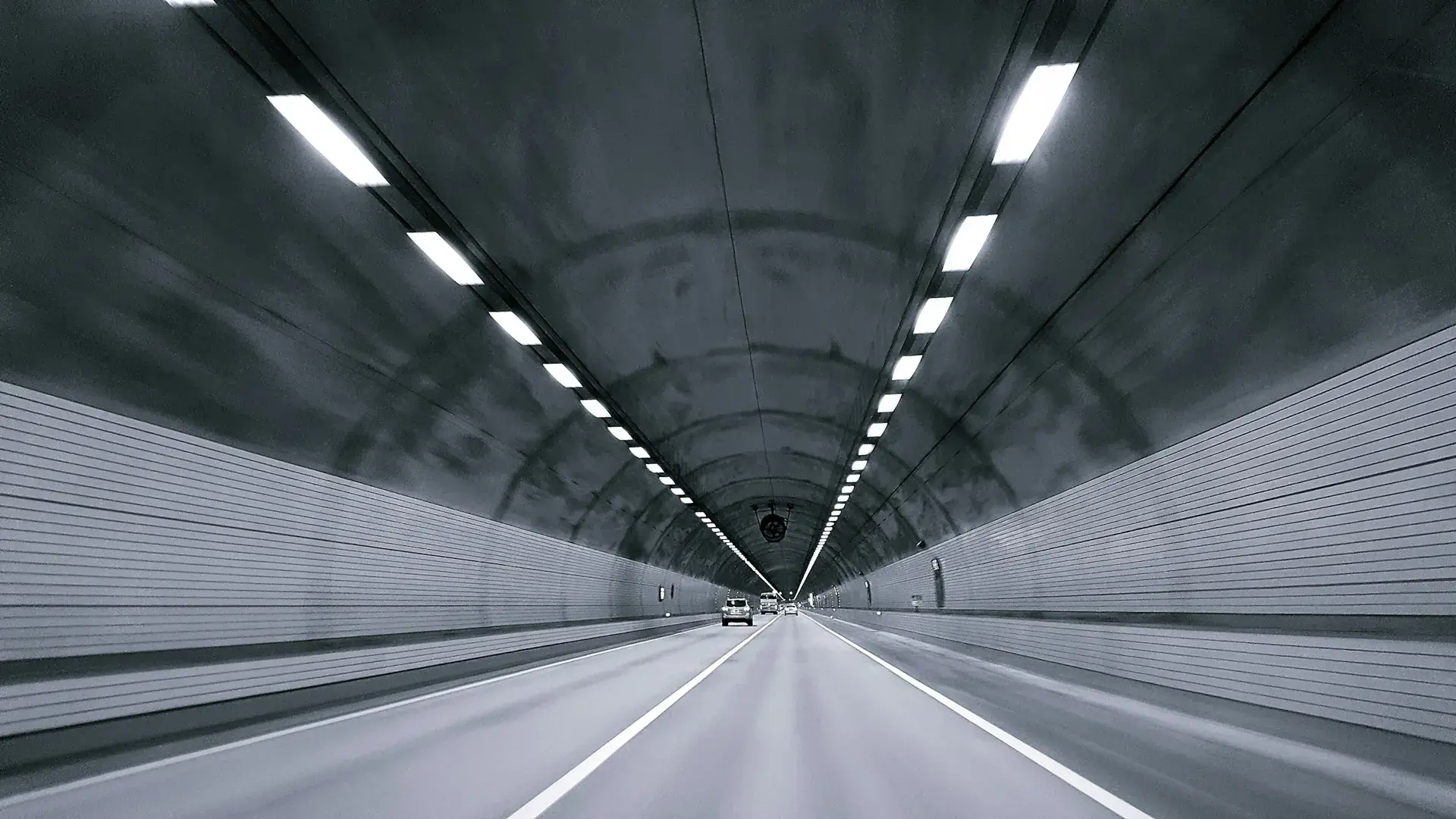
AS 4825-2011, Tunnel fire safety, is the Australian Standard for fire safety in new road, rail and bus tunnels (Standards Australia). It does not tell a designer to fit deluge or water mist. It sets a performance-based framework, and whichever fixed fire fighting system (FFFS) a tunnel uses has to earn its place in the fire safety engineering analysis.
What does AS 4825 cover?
Standards Australia committee FP-023, Tunnel Fire Safety, prepared the standard, published on 1 February 2011. Its members included Austroads, the Australasian Fire and Emergency Service Authorities Council, CSIRO, the Australian Tunnel Operators Group, and road and rail authorities from New South Wales, Queensland and Western Australia.
It gives guidelines for fire safety in new road, rail and bus tunnels, uni-directional or bi-directional, and addresses the tunnel and station interface for rail and bus tunnels. It is not written for existing tunnels, although its principles can guide an upgrade. It does not apply to funicular, service, pedestrian or bicycle tunnels, railway and bus stations, or tunnels for vehicles with no one on board, and it covers neither the transport of dangerous goods nor fire safety during construction (AS 4825 preview).
Standards Australia lists the 2011 edition as pending revision, so check whether a new edition has been published before a project relies on it.
Does AS 4825 prescribe deluge or water mist?
Neither. The committee chose a performance-based format to match Australian practice, drawing on fire safety engineering methods like those in the International Fire Engineering Guidelines. The standard is informative: it recommends performance, offers trial concept designs and acceptance criteria, and does not restrict innovative approaches or new technology, provided the required performance can be demonstrated. Its referenced documents list AS 2118.3 for deluge systems and AS 4587 for water mist, alongside NFPA 502, NFPA 750, and PIARC and UPTUN guidance.
The foreword explains why. Traffic volume, the nature of the vehicles, tunnel length and traffic conditions all change the risk, so fire safety measures adequate for one tunnel may not be adequate for another that looks similar. The acceptability of a design is a matter for all the stakeholders, including the authorities with a regulatory function, the owner and the operator.
How does AS 4825 classify a tunnel?
For the initial concept design, AS 4825 classifies a tunnel on four criteria:
- Length: long if it is longer than 120 m for a road or bus tunnel, or 250 m for a rail tunnel;
- Traffic condition (road tunnels only): high or low volume, or likelihood of congestion;
- Direction of traffic: uni-directional or bi-directional;
- Intersections: none, or one or more.
The classification sets preliminary fire safety measures; the fire safety engineering analysis then tests them against the acceptance criteria.
What do Australian road tunnels use today?
Austroads' data set on Australia's eleven major road tunnels covers tunnels that are uni-directional or longer than 1 km, carry high traffic volumes in urban areas and are run from continuously staffed control centres. It records 78 fires, from the opening of the Sydney Harbour Tunnel in August 1992 to June 2016 (Austroads AP-T341-19). Austroads says the data captures the extent of use of the tunnels' fixed fire fighting systems, which it describes as deluge systems, so that others considering such systems can draw on it (Austroads).
PIARC, the World Road Association, puts the international picture the same way: water-based deluge systems are by far the most common FFFS in tunnels today, available in low-pressure and high-pressure forms, the high-pressure ones with smaller droplets. It recommends that the choice of system rest on a cost-benefit analysis and that an FFFS be considered together with the ventilation (PIARC Road Tunnels Manual).
In PIARC's terms, then, a zoned high-pressure water mist system is a form of water-based deluge: open nozzles, operated zone by zone, with smaller droplets. The real design choice is droplet size, pressure and water demand, and the evidence behind each.
Deluge or water mist: what should the comparison show?
AS 4825 leaves the choice to the fire safety engineering analysis, so compare both systems on the same design fire and the same acceptance criteria:
- the design fire and the objective: control, suppression, or tenable conditions for self-rescue and firefighting;
- full-scale fire test evidence for each proposed system at the proposed zone length and ventilation velocity;
- water demand and storage, and the tunnel drainage the discharge feeds;
- interaction with ventilation and detection;
- inspection, testing and maintenance under the AS 1851 series.
For the water demand arithmetic, see water mist vs deluge in tunnels; for what full-scale tunnel fire testing has shown, see the SOLIT tunnel fire tests.
Where Mistelix stands
Mistelix designs zoned high-pressure water mist systems for road, rail and metro tunnels with reference to NFPA 502, NFPA 750 and EN 14972; see our tunnel fire fighting systems page. Full-scale tunnel fire testing is planned, and our live status against every standard we work to is in our approvals ledger.
Sources: Standards Australia, AS 4825-2011 product page and preview, for the committee, preface, foreword, scope, limitations, classification and referenced documents summarised above; Austroads, AP-T341-19 (19 March 2019) and its release; PIARC, Road Tunnels Manual: fixed fire fighting systems.